




For most of pickleball’s history, surface technology was simple: raw T700 carbon fiber, exposed weave, break it in and then slowly watch your spin potential fade as the face polished smooth. The math was unforgiving — more strikes meant a flatter surface, and a flatter surface meant fewer RPMs on every dink, drive, and drop. Players treated paddle faces like tires, budgeting for the inevitable decline.
That calculus is changing fast, thanks to a new generation of factory-applied grit surfaces that don’t just last longer — they can actually improve as they wear in.
What the New Grit Actually Is
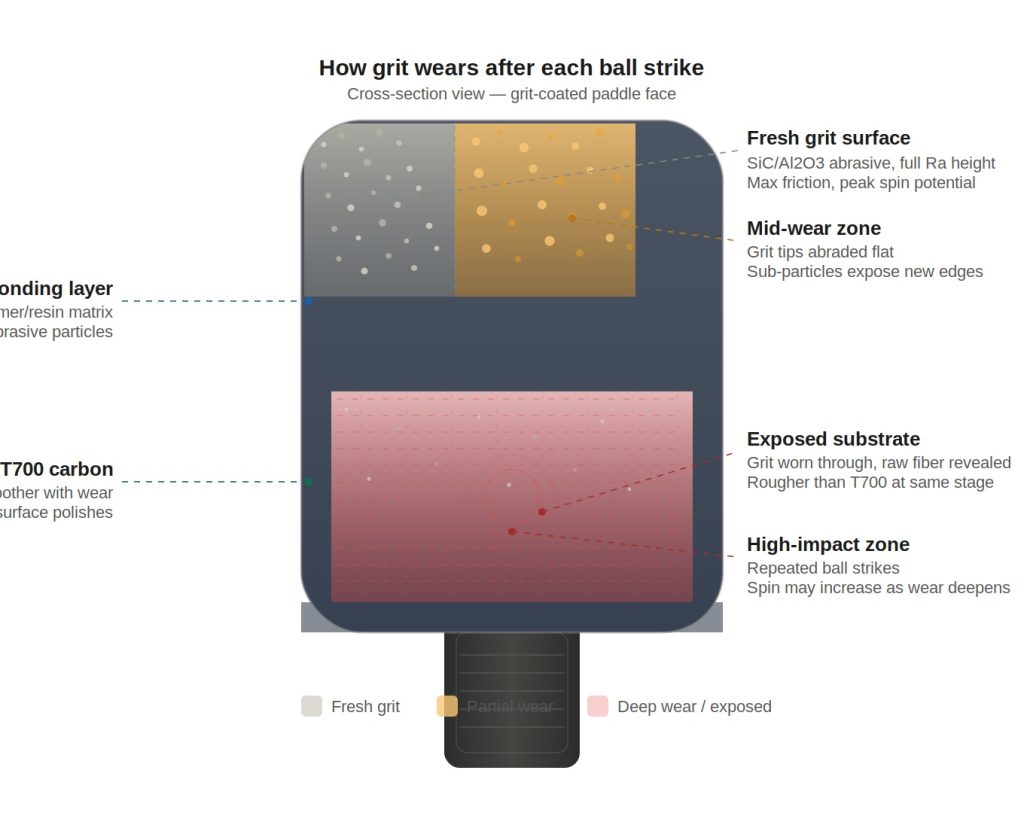
The coatings appearing on paddles from brands like Ronbus, Six Zero, and others are not paint or simple texture. They are engineered abrasive layers, typically composed of silicon carbide (SiC), aluminum oxide (Al₂O₃), or in some advanced applications, boron carbide (B₄C) — the same families of abrasives found in industrial grinding wheels and aerospace composites. Particles are suspended in a polymer resin matrix and bonded directly to the carbon fiber substrate, creating a surface with measurable Ra (average roughness) values well above what raw T700 can achieve.
On a profilometer, a fresh grit face will show tall, sharp peaks across the surface profile. These peaks are what generate spin — they dig fractionally into the ball’s surface during contact, increasing friction and torque. The coefficient of friction (CoF) is significantly higher than uncoated carbon, and USAPA’s ESM (Enhanced Surface Material) testing has forced the sport’s governing bodies to draw new lines around just how grippy a paddle face can legally be.
The Wear Paradox
Here is where grit technology diverges sharply from its T700 predecessor, and where the physics gets genuinely counterintuitive.
With raw carbon fiber, surface wear is a one-way street. The woven fiber strands are the highest point on the surface to begin with. Every ball strike microscopically abrades those peaks, flattening the weave crown and reducing surface roughness. The face gets measurably smoother over time. A T700 paddle fresh from the factory is, in most cases, the best it will ever feel for spin generation.
Grit paddles behave differently because the abrasive particles are embedded in a matrix, not the surface itself. In the early wear phase, the very tips of the grit particles abrade away — much like a whetstone losing its highest peaks. This can cause a brief dip in friction. But as the polymer binder continues to wear, it exposes more particle depth and new sub-particle edges. The surface does not polish — it excavates. Fresh abrasive material is continuously revealed from below, and the jagged micro-geometry at those newly exposed edges can be rougher than the original factory surface.
The result is a wear curve that looks nothing like T700. Rather than a steady decline, many grit-coated paddles show a break-in plateau, followed by a period of stable or even increasing spin performance as the coating matures. Players on forums and Discord communities tracking their paddle through hundreds of hours of play report that a well-worn grit face often generates more consistent spin than the same paddle on day one — once the factory-fresh top layer has settled.
What This Means for Durability and Design
The implications for paddle lifespan are significant. T700 players chased freshness — playing with a new paddle whenever budget allowed, or employing surface-refreshing techniques that were often inconsistent. Grit paddle owners are developing a different vocabulary: break-in periods, peak wear windows, and tracking whether a paddle has reached its optimal abrasive depth.
Not all grit formulations age equally. Particle size, bonding agent hardness, and coating thickness all determine how long the improvement phase lasts before the abrasive layer fully depletes. Thicker coatings extend the useful life but add weight and change swing characteristics. Finer particles wear faster but can deliver a more consistent friction profile throughout their lifespan.
Engineering teams are now approaching the coating almost like a consumable system — designing it to release abrasive material at a predictable rate, maintaining a target roughness profile across the paddle’s service life rather than simply maximizing day-one performance.
The Performance Ceiling and Regulatory Tension
None of this exists in a vacuum. USAPA and USA Pickleball have tightened surface testing protocols specifically because grit coatings pushed friction values well beyond what the sport’s ball flight and play style were designed around. Several high-grit paddles have lost or never received approval, and the ABI (Abrasion and Bounce Integrity) testing framework continues to evolve.
The paradox for regulators is the same wear curve that makes these paddles more durable also makes them harder to test at a fixed point in time. A paddle that passes ESM testing at manufacture might exceed thresholds after 20 hours of break-in — or might technically be non-compliant fresh out of the box but become compliant as its sharpest peaks wear down.
For players, the practical takeaway is straightforward: if you are playing with a grit-coated paddle, the face you have after your first hundred rallies is not the face you started with — and depending on the formulation, that might be very good news.